There’s a particular kind of paralysis that comes from treating every major decision as permanent.
The new career has to be the *right* career. The new direction has to be fully formed before you present it to anyone. One wrong move and you’ve wasted years, burned credibility, and confirmed what the skeptical part of your brain has been saying all along.
Under that kind of pressure, most people don’t move at all.
**The Lab vs. The Bet**
The antidote isn’t lowering your standards. It’s changing your relationship with uncertainty.
Instead of treating your professional life as a series of high-stakes bets — where you need the right information, the right conditions, and the right version of yourself before you’re allowed to act — you treat it as a laboratory. You form hypotheses. You run experiments. You collect data. And you adjust based on what you find, without treating every imperfect result as a failure.
This reorientation changes the cost of being wrong in a very practical way. Commit a decade to a single grand plan and it fails — the loss is enormous. Commit thirty days to a single experiment and it fails — you’ve lost thirty days and gained genuinely useful information. The iterative approach converts potentially catastrophic failures into affordable ones.
**What This Actually Looks Like**
The iterative mindset rests on three practices that work together.
The first is small moves over grand plans. Grand plans are satisfying to make and brittle to execute. They require conditions to stay stable, information to stay accurate, and you to remain the same person you were when you made the plan. Small, continuous adjustments work because they require much less certainty upfront. Instead of asking “what’s the perfect next career?”, you ask “what’s one thing I can test this month?” The first question is nearly impossible to answer with any confidence. The second one isn’t.
The second is assessing setbacks as neutral data. When something doesn’t work, the default response is either to blame yourself or to blame the circumstances. Both are expensive. Neutral assessment does something more useful: it asks, simply, what does this tell me about what to try differently? Setbacks treated as data improve your next experiment. Setbacks treated as verdicts stop you from running one.
The third is deliberate practice — identifying the specific skill or behavior your next chapter requires and building it with intention, rather than waiting for capability to arrive on its own.
**The Permission You’re Not Giving Yourself**
Most people are waiting for certainty before they’re willing to move. The research on how reinvention actually works says something different: the certainty comes *after* the movement, not before. The path is made by walking it.
What the iterative mindset provides isn’t a guarantee of the right outcome. It’s a method for staying in motion long enough to find out — without requiring you to bet everything on a single, perfect first attempt.
That turns out to be more than enough.
—
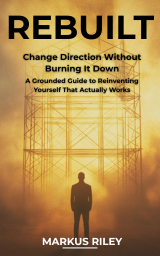
*You don’t need the perfect plan. You need a better relationship with imperfect action.* **Rebuilt** gives you the iterative framework that keeps reinvention moving — without requiring you to get it right the first time.
** Click the cover below and get your copy now.**