
Author: teds

  • The Hidden Cost of Staying: Why “Playing It Safe” Is Riskier Than You Think

    Staying put feels safe. The mortgage gets paid. The routine holds. Nothing blows up.

    There’s a certain comfort in the familiar — even when the familiar stopped fitting years ago. And for a lot of people, that comfort becomes the primary argument against change: *at least I know what I’ve got.*

    But here’s what that argument consistently gets wrong: staying in a life that no longer fits isn’t neutral. It has a cost. A real, measurable, cumulative cost. And by the time most people add it up honestly, they’ve spent years quietly paying it.

    ### What Stagnation Actually Feels Like

    The cost of a misaligned life rarely arrives as a crisis. It doesn’t announce itself with a dramatic moment of reckoning. Instead, it shows up as something much harder to name — a low-grade flatness that follows you through your workday. A creeping sense that the person you’ve become at work is a performance you no longer quite believe in.

    You’re competent. You’re reliable. Your colleagues respect you. You just stopped caring somewhere along the way, and you’re not entirely sure when.

    That’s the Identity Threshold — the point where the gap between who you are and who you’ve been performing slowly becomes impossible to paper over. Skills, experience, and reputation pointing one direction. Actual desires, energy, and interests pointing somewhere else entirely.

    Most people recognise this feeling. Few people name it for what it is.

    ### The Real Numbers Behind Career Disengagement

    This isn’t just a feeling. Research on chronic work disengagement consistently links it to measurable, real-world consequences. Higher rates of anxiety and burnout. Disrupted sleep. A gradual erosion of the drive and ambition that once felt natural.

    More practically: people who stay in roles that no longer fit tend to underperform over time. They stop developing. They stop advocating for themselves. The career plateau they were trying to protect by staying arrives anyway — just without any of the growth that might have come from choosing a different path.

    There’s a skill erosion argument worth sitting with too. In most industries, standing still isn’t neutral. While you’re maintaining, others are building. The longer the gap between where you are and where you want to be, the more ground you’ll need to cover when you eventually decide to move. And that decision almost always comes — the question is just whether you make it proactively or reactively.

    ### Why Knowing Isn’t Enough

    Here’s something that almost never gets addressed: most people who are stuck already know they’re stuck. They’ve known for a while. They can articulate the problem clearly, name what’s missing, describe in reasonable detail what a better version of their life might look like.

    And then they don’t move.

    This isn’t a failure of self-awareness. It’s something more specific — a gap between intellectual understanding and emotional readiness that psychologists describe as cognitive dissonance. You hold two contradictory beliefs simultaneously: *I need to change* and *changing is too risky.* Both feel true. And as long as they coexist at roughly equal weight, the result is paralysis dressed up as caution.

    The mind resolves this dissonance in predictable ways. It finds reasons to wait. It convinces you the timing isn’t right, that you need more information, that the responsible thing is to stay put a little longer. None of this is conscious deception — it’s your brain genuinely trying to protect you from the discomfort of uncertainty.

    What breaks the stalemate isn’t more information. You already have enough. What breaks it is making the cost of staying feel as real and as immediate as the fear of moving.

    ### The Comfort of a Known Misery

    There’s a subtler dynamic worth naming: the comfort of a known misery. A dissatisfying situation you understand completely feels safer than an uncertain one that might be better. The familiar has a gravitational pull that has nothing to do with its actual quality.

    Naming that pull for what it is — a cognitive bias, not a signal — is the first step toward moving despite it.

    If you’ve been romanticising your current situation because at least you understand it, that’s not wisdom. That’s your nervous system doing what nervous systems do: minimising threat, maximising predictability, at the expense of growth.

    ### The Alignment Audit: Seeing the Gap Clearly

    One practical tool for making the cost of staying visible is something called the Alignment Audit.

    Draw a simple two-column table. In the left column, write where you actually are across five areas: your work, your relationships, your daily energy, your sense of purpose, and how you spend your free time.

    In the right column, write how you want to *feel* in each of those areas. Not what you want to have — how you want to feel.

    The gaps you find aren’t indictments. They’re data. And data is the only honest place real change can start.

    Identify the single largest gap. That’s the one worth paying attention to first.

    You don’t have to act on it this week. But you do have to look at it. Because the longer you don’t, the more expensive the delay becomes.

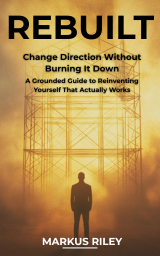
    Click here to learn more about REBUILT

  • The Reinvention Myth Nobody Talks About (And What Real Change Actually Looks Like)

    There’s a story most of us have absorbed about what reinvention looks like. You hit a wall. You quit the job, sell the house, buy the one-way ticket. The montage begins. Eighteen months later, everything clicks. Credits roll.

    It’s a compelling story. It’s also almost entirely fiction.

    The people who actually pull off meaningful reinvention rarely do it through a dramatic gesture. They do it quietly, in parallel with the life they’re already living, through a series of small and deliberate moves that most of the people around them barely notice.

    They don’t burn the old life down. They build the new one alongside it — piece by piece — until the day they realise they’ve already crossed over.

    ### Why the “Clean Break” Fantasy Keeps You Stuck

    The dramatic reinvention story is appealing for a reason. It’s clean. It has a clear before and after. It requires one big decision rather than a hundred small ones.

    But it’s also a story that keeps most people from starting. Because if reinvention requires a crisis — a rock bottom, a breakdown, a burning platform — then anyone who doesn’t have one yet has permission to wait.

    And waiting is exactly what the part of you that doesn’t want to change is hoping you’ll do.

    Real change doesn’t ask for a crisis. It asks for consistency. Not for a single courageous leap, but for the willingness to keep taking small, deliberate steps over a longer period than feels comfortable. The people who succeed at reinvention aren’t braver than everyone else. They just stopped waiting for the perfect moment to arrive.

    ### The Identity Threshold: The Moment Most People Miss

    Buried inside every genuine reinvention is a specific moment that almost nobody talks about. Psychologists and researchers who study adult development sometimes call it the Identity Threshold — the point at which your current self-concept stops being a foundation and starts being a ceiling.

    You’ve built something. A career, a reputation, a set of roles and relationships that define how you move through the world. And for a long time, that structure served you well. But at some point — gradually, quietly, almost imperceptibly — the person you’ve become at work, or at home, or in your own head, stopped matching the person you actually are underneath it.

    The skills, the experience, the reputation all point in one direction. Your actual interests, energy, and desires point somewhere else. You file the gap under “someday” and keep moving.

    But it doesn’t close on its own. Left alone, it widens.

    The Identity Threshold is the moment when that gap becomes impossible to ignore — when the self-concept that used to feel like identity starts to feel like a cage. Most people experience it as restlessness, flatness, or a creeping suspicion that the version of themselves they’ve built isn’t the finished one.

    If any of that sounds familiar, you’re probably closer to yours than you think.

    ### You Don’t Need a Rock Bottom

    Here’s the thing nobody tells you: you don’t need to hit bottom before you’re allowed to change direction. You don’t need a crisis. You don’t need permission from the people who knew you as the previous version of yourself.

    You need a starting point. And — critically — a map.

    The myth of the clean break is damaging not just because it’s inaccurate, but because it implies that the only valid catalyst for change is catastrophe. That a growing sense of misalignment isn’t enough. That unless things are actively falling apart, staying put is the responsible thing to do.

    It isn’t. Staying put has a cost too — a real, measurable cost that compounds quietly over years. It just doesn’t announce itself the way a crisis does.

    ### What Reinvention Actually Requires

    Research on how adults successfully navigate major life transitions points to a consistent set of conditions. Not courage in the cinematic sense. Not a willingness to gamble everything. But:

    – **Honest self-assessment** — a clear-eyed look at where you actually are, separate from where you’re supposed to be

    – **A tolerance for uncertainty** — not comfort with it, just the ability to keep moving through it

    – **Small, reversible experiments** — actions that generate real data without requiring you to bet the whole thing on one outcome

    – **The right framework** — an understanding of what’s actually happening inside you, and around you, during a period of genuine change

    The dramatic leap makes for a better story. But the quiet crossing — built move by move, with real tools and genuine self-knowledge — is what actually works.

    The path isn’t made in advance. It’s made by walking.

    And the walking can start today.

    Click here to learn more and get your copy of REBUILT

  • The Path Is Made by Walking It

    There’s a Spanish proverb that captures something true about how real change works.

    *Caminante, no hay camino, se hace camino al andar.*

    Traveler, there is no path. The path is made by walking.

    Most people spend a significant portion of their lives waiting for the path to appear before they’re willing to take the first step. They want certainty before commitment, clarity before action, proof before investment. And so they wait — sometimes for years, sometimes indefinitely — for conditions that were never going to arrive on their own.

    **The Crossing**

    What *Rebuilt* has tried to show, across every chapter, is that the certainty comes after the walking. Not before. The clarity that feels like a prerequisite is actually a result — something you earn through movement, not something you wait for in stillness.

    You now understand why staying stuck has a cost that rarely gets calculated honestly. You know how the brain’s own mechanisms work against sustained motivation, and how to disrupt that pattern before it completes. You have a framework for changing direction through small, iterative moves rather than high-stakes bets. You know how to protect your sense of self through a transition that would otherwise feel like dismantling it. You have a tactical approach for building toward something new without abandoning what you’ve already built. You understand that character can be developed deliberately — that the traits your next chapter requires don’t have to wait to be given to you. You know how to close the learning gap faster than you thought possible. You know what the messy middle actually feels like, and how to navigate it. And you have a set of practices for staying in motion long enough for the work to compound.

    That’s a complete set of tools. The question now is whether you’ll use them.

    **One More Thing Worth Saying**

    Most people who are experiencing misalignment don’t examine it. They manage it. They find ways to make the discomfort liveable, develop small rituals of avoidance, and gradually lower their expectations of what their professional life could be.

    The fact that you’ve engaged seriously with the question of how to change means you’ve already cleared the first and arguably hardest obstacle: the willingness to look honestly at where you are.

    What comes next is the longer, quieter work of turning that willingness into consistent action. It won’t be linear. There will be weeks where everything moves and weeks where nothing seems to. There will be moments of genuine confidence followed by moments of genuine doubt — sometimes within the same afternoon.

    That oscillation isn’t a sign that something is wrong. It’s what progress actually looks like from the inside.

    Keep walking.

    *You have everything you need to start.* **Rebuilt** — the complete, grounded framework for changing direction without burning everything down.

    **👇 Click the cover below to learn more and get your copy now.**

  • The Part That Quietly Kills Most Reinventions

    Getting started with reinvention is hard. Sustaining it over the months and years it actually takes is harder.

    The initial clarity — the energy that comes from finally deciding to move — is real. But it’s temporary. At some point the novelty wears off. Progress slows. The people around you express skepticism, concern, or outright opposition. The world, indifferent to your personal transformation project, keeps throwing complications at you.

    This is where most reinventions quietly die. Not through a dramatic reversal. Through gradual erosion. Energy gets redirected. Priorities shift. The goal that felt urgent six months ago gets filed under “eventually.” And eventually never comes.

    **The Hidden Drain on Your Energy**

    One of the most reliable drains on reinvention momentum is one that rarely gets named: managing other people’s reactions to your choices.

    The colleague who thinks you’re making a mistake. The family member whose concern sounds suspiciously like disapproval. The friend who keeps asking whether you’ve really thought this through. These interactions cost more than they appear to. Each one requires you to defend, explain, or justify a decision you’ve already made and are already living with.

    Over time, the accumulated weight of others’ skepticism can do more damage to your momentum than any practical obstacle.

    The reorientation that helps is simple but not easy: you cannot control how other people respond to your reinvention, and attempting to do so is a significant waste of finite energy. Their reaction is data about them, not a verdict on your choices. The people whose opinions actually deserve weight in your decision-making are a small group — those who know your situation well, genuinely want good things for you, and have relevant experience. Everyone else’s reaction, however confidently expressed, doesn’t need to be processed as meaningful feedback.

    **Resilience as a Practice**

    Here’s something worth understanding: resilience during reinvention isn’t a trait you either have or don’t. It’s a set of practices — and like every other practice in *Rebuilt*, it can be built deliberately.

    That means responding rather than reacting to setbacks. It means building physical anchors — regular exercise, consistent sleep, the small daily routines that keep your nervous system from running at a permanent red line — because the people who maintain these practices during high-stress transitions consistently report greater emotional steadiness than those who deprioritise them exactly when they’re most needed.

    It also means building what the book calls deliberate joy: intentional sources of energy and pleasure that exist separately from the transition itself. Hobbies. Relationships. Projects that exist for their own sake. Not as rewards for progress, but as non-negotiable parts of the structure of your days.

    **The Consistency That Compounds**

    The people who make it through to the other side of reinvention are not the ones who avoided difficulty. They’re the ones who found a way to stay in motion when the difficulty arrived — as it always does.

    They built systems rather than relying on motivation. They kept their range of identity anchors intact. They stopped trying to bring the skeptics around. And they kept moving.

    None of that is glamorous. All of it works.

    *Most reinventions don’t fail dramatically. They erode quietly.* **Rebuilt** gives you the resilience practices that keep your momentum alive — through the long middle, the skeptics, and everything the world throws at you along the way.

    **👇 Click the cover below to learn more and get your copy now.**

  • Nobody Warns You About This Part of Reinvention

    There’s a phase of reinvention that almost nobody prepares you for.

    Not the beginning — that part has a certain energy to it. The clarity of a decision finally made. The relief of committing to something. It feels like movement, because it is.

    Not the end, either — when the new chapter is established and you can look back on the transition with perspective and a clean narrative.

    The part nobody warns you about is the middle.

    **What the Middle Actually Feels Like**

    The middle is the stretch between deciding to change and actually arriving somewhere new. It has a specific texture. Financial pressure that ebbs and flows. An identity that feels genuinely suspended between what you were and what you’re becoming. A social environment that doesn’t quite know how to relate to you anymore. And a timeline that keeps extending beyond what you originally estimated.

    Most reinventions take longer than the person going through them expected. The middle is where that gap lives.

    One of the genuinely disorienting aspects is that you no longer have a clean answer to the question “what do you do?” The old answer is outdated. The new answer isn’t fully true yet. So you give a version that feels slightly like lying in both directions, and then you go home feeling vaguely fraudulent.

    This is normal. It’s also temporary. But while you’re in it, the absence of a clear professional identity creates a specific kind of low-grade anxiety that’s worth understanding rather than just enduring.

    **Building a Transition Narrative**

    The anxiety isn’t really about the question. It’s about the underlying uncertainty it surfaces: who am I if I’m not clearly one thing?

    There’s a practical step that helps with this considerably. Develop a transition narrative — a brief, honest account of where you are and where you’re heading that you’re genuinely comfortable saying out loud. Not a polished elevator pitch, not a defensive explanation. A confident sentence or two that acknowledges the transition without apologising for it.

    Something like: “I spent ten years in logistics management and I’m building toward supply chain consulting — I’ve been doing some project work in that space while I make the shift.” That’s true. It’s forward-looking. And it doesn’t require you to pretend the transition isn’t happening.

    People respond well to honest transition narratives. What makes them uncomfortable isn’t your uncertainty — it’s the awkwardness of someone who clearly doesn’t know how to talk about their own situation. Confidence in how you describe where you are communicates more than the content of the description.

    **The Temptation to Abort**

    Somewhere in the middle, there’s usually a moment when stopping the whole thing starts to feel like the reasonable option. Not giving up — reframing. Being practical. Recognising that you have responsibilities.

    This moment is almost always a product of accumulated fatigue rather than a genuine reassessment of the goal. It arrives when the runway is shrinking, when a recent attempt produced nothing, when someone whose opinion you respect expresses doubt. It feels like clarity. It’s usually fog.

    *Rebuilt* gives you the tools to tell the difference — and to use the messy middle for what it’s actually good for.

    *The middle of reinvention is where most people quietly give up. It doesn’t have to be.* **Rebuilt** prepares you for the phase nobody talks about — and shows you how to navigate it without losing momentum.

    **👇 Click the cover below and get your copy now.**

  • The Learning Gap Is Smaller Than It Looks (If You Know How to Close It)

    Every significant shift in the professional world creates a dividing line between people who adapt early and people who adapt late. The internet created one. Mobile did. Cloud computing did. Each time, the people who engaged with the new tools while they were still unfamiliar gained advantages that compounded quietly over years.

    Artificial intelligence is the current dividing line. And the people who feel most uncertain about it — mid-career professionals who built their expertise before these tools existed — are precisely the people who stand to benefit most from using them.

    **The Learning Gap Problem**

    For career changers, the biggest practical barrier is usually the gap between your current knowledge base and the knowledge required to credibly operate in a new field. That gap used to take years to close — through formal education, expensive certifications, or slow accumulation of on-the-job experience. For many people it simply felt insurmountable, which is one of the main reasons serious career changers so often delay the actual move indefinitely.

    AI tools, used well, compress that timeline significantly. Not by providing shortcuts that bypass real understanding, but by making the learning process more efficient, more personalised, and more immediately applicable to where you’re actually trying to go.

    The goal isn’t to become an expert from scratch. It’s to build enough working knowledge to operate credibly in a new context. That’s a much smaller target than it initially appears — and it’s reachable in weeks rather than years.

    **How to Use It as a Teacher, Not a Search Engine**

    The most common mistake is using AI tools the way you’d use Google — asking for quick answers rather than genuine understanding. That produces information without comprehension, which is nearly useless for building real capability.

    A more effective approach is to treat it as a patient, knowledgeable teacher with unlimited time to explain things at exactly the level you need. The key is in how you frame your questions.

    Instead of “explain data analytics,” try: “I have a background in operations management and I’m trying to understand how data analytics applies to supply chain decisions. Can you explain it in terms of the frameworks I already use, and give me a concrete example from that context?” That framing produces an explanation that actually lands — one calibrated to your existing knowledge rather than floating past you in abstraction.

    This approach generalises across any knowledge domain. Structured AI conversations, each building on the previous one, can bring you from unfamiliar to credibly functional in a new field in a matter of weeks. The timeline for closing the learning gap is not what it was five years ago.

    **Communication Clarity**

    Beyond learning acceleration, there’s a second capability that matters directly for anyone changing direction: help with how you talk about yourself.

    Career changers frequently struggle to articulate their value in new contexts. The vocabulary of a previous field doesn’t translate automatically. Describing your background to a hiring manager, a client, or a colleague in a different industry requires translation work that most people find genuinely difficult to do alone.

    AI handles this well — and it’s one of the most immediately practical applications for anyone mid-transition.

    *The learning gap between where you are and where you want to be is smaller than it looks.* **Rebuilt** shows you how to use technology as a genuine accelerator — not a gimmick, but a real tool for closing the distance faster.

    **👇 Click the cover below to learn more and get your copy now.**

  • Your Personality Isn’t Fixed. Here’s What the Research Actually Says

    There’s a belief, surprisingly persistent given the evidence against it, that personality is fixed. You’re either an introvert or you’re not. You’re either naturally confident or you’ve always been a little anxious in professional settings. The traits you were born with — or developed early — are the ones you carry forever.

    The research tells a different story.

    **What Actually Changes**

    Personality researchers have spent decades tracking how character develops across adulthood. The consistent finding is that people shift meaningfully on all five major personality dimensions as they age — particularly when life circumstances push them toward new demands.

    More importantly, that shift doesn’t have to wait for circumstances to push it. You can identify which trait your next chapter actually requires, choose behaviors that express that trait, and practice those behaviors deliberately until they become more natural.

    The trait follows the behavior — not the other way around.

    This matters directly for reinvention. Moving into a new professional context almost always requires some behavioral shift. A technical specialist moving into leadership needs a wider range of extroverted behavior. Someone who’s spent years in a highly structured environment needs more openness to ambiguity. A chronic people-pleaser moving into negotiation-heavy work needs the specific capacity to hold a position under pressure and not walk it back.

    Waiting for these qualities to arrive on their own is a strategy that rarely works. Building them deliberately is one that does.

    **What Counter-Default Behavior Actually Looks Like**

    The most reliable technique is what researchers call counter-default behavior: deliberately doing the thing your current default would have you avoid.

    For someone low in extraversion, that might mean volunteering one opinion in a meeting where they’d normally stay quiet. Not performing extroversion, not becoming a different person — just introducing one behavior that sits outside their current range. For someone high in agreeableness who struggles to hold a position under pressure, it might mean stating a disagreement once, clearly, and not walking it back when pushed.

    The point isn’t the single action. The point is repetition. Each time you execute the counter-default behavior, you’re building a slightly wider behavioral range. Over weeks and months, behaviors that initially required significant deliberate effort start to require less. The trait shifts.

    **The Discomfort That Means It’s Working**

    One of the most common reasons people abandon this kind of work early is that it feels inauthentic. Acting more assertively, or more openly, or more socially — it can feel like wearing someone else’s clothes.

    Here’s the reframe: discomfort during counter-default behaviors isn’t a sign that you’re faking it. It’s a sign your nervous system is doing something new. That feeling of inauthenticity tends to diminish with repetition, for exactly the same reason any new skill feels unnatural at first and progressively more natural over time.

    You don’t have to wait to become someone different before you can act like someone different. The acting comes first. The becoming follows.

    *Who you are right now isn’t who you have to be.* **Rebuilt** shows you how to deliberately build the character qualities your next chapter requires — backed by real research, not wishful thinking.

    **👇 Click the cover below to learn more and get your copy now.**

  • Why Most Career Pivots Fail (And What Actually Works Instead)

    Most career pivots fail less often because of bad strategy and more because of unclear starting conditions.

    People begin the process without an honest account of what they bring, what they need, and what they’re genuinely willing to trade. The result is a lot of unfocused activity that generates exhaustion without traction. A lot of applications that don’t lead anywhere. A lot of conversations that feel promising and then go quiet. And eventually, a return to the status quo with slightly less confidence than before.

    The tactical framework that actually works looks quite different.

    **Start With Honest Ground**

    Before updating your resume or reaching out to contacts, there are two foundational questions worth sitting with seriously. What do you actually have to offer? And what do you actually need in return?

    The first part is easier than most people expect. If you’ve been working in a field for any length of time, you’ve accumulated skills, relationships, domain knowledge, and a track record. Not all of it transfers cleanly to a new direction — but more of it transfers than most career changers initially assume.

    The second part is harder, because it requires honesty about non-negotiables. Many people begin a transition with a vague aspiration — “something more meaningful,” “better work-life balance” — without translating that into specific requirements. That vagueness makes it nearly impossible to evaluate opportunities clearly. Every option sounds potentially good. Nothing feels definitively right. Decisions get deferred indefinitely.

    When you know your actual requirements — a salary floor, a specific work structure, the kind of work that genuinely energises you — you can evaluate what’s in front of you with real clarity. The decision that took four months to make becomes one you can make in two days.

    **Bridges, Not Leaps**

    The most durable career pivots tend to be built on bridges, not leaps. A bridge uses what you already have — your current skills, your existing employer, your established reputation — to fund your movement toward something new. A leap discards all of that and starts from zero.

    Leaps feel more dramatic and more honest. They’re also significantly riskier and slower than most people expect.

    Building a bridge looks different for everyone, but the underlying logic is identical: use your current position to develop the skills, relationships, and credibility that your target context requires — before you make the move. Internal projects that mirror your target role. External visibility in your new field, built quietly alongside your day job. Informal work in the new direction, done carefully, before the formal transition.

    The result is that when you do make the move, you’re not starting from zero. You’re converting an existing track record into a new context. The difference in outcomes is not small.

    **The Timeline Question**

    The bridge approach feels slow. It usually isn’t, relative to the alternative. Cold transitions into new fields typically take two to three years to produce stable income. Bridge transitions, done well, can produce a functioning new career in a fraction of that time.

    The question isn’t whether to move. It’s whether you want to move well.

    *You don’t need to blow everything up to change direction.* **Rebuilt** gives you the tactical framework for building a bridge to your next chapter — using what you already have.

    **👇 Click the cover below to learn more and and get your copy now.**

  • The Career Isn’t the Problem. Your Identity Is Tied to It.

    When people describe a career crisis, they often use language that sounds more like grief.

    *”I don’t know who I am anymore.”*

    *”I’ve given everything to this job.”*

    *”If I leave, what’s left?”*

    That language isn’t melodramatic. For many people, a professional role becomes so central to their sense of self that threatening the role feels like threatening the person. And that’s exactly why so many people stay stuck long past the point where staying makes any rational sense.

    The problem isn’t a lack of options. It’s that exploring those options feels like dismantling the only version of themselves they trust.

    **How Identity Fusing Happens**

    It starts gradually. Early in a career, most people carry a relatively broad sense of self — professional, yes, but also a friend, a sibling, a hobbyist, maybe a partner or a parent. Work is one piece of the picture.

    Over time, for many people, that picture narrows. The career demands more. Other roles get deprioritised. The professional identity grows larger relative to everything else, until it’s not just the biggest piece of the picture — it’s essentially the whole thing.

    Research on professional identity makes this risk concrete: people whose sense of self is dominated by a single role are significantly more vulnerable to psychological disruption when that role is threatened. Redundancy, burnout, a transition that doesn’t go smoothly — any of these can feel catastrophic when the threatened role is the primary source of self-worth.

    **What Protects You**

    The solution isn’t to care less about your work. The people who navigate reinvention best don’t have smaller professional ambitions. They have multiple anchor points.

    They’re a professional, yes — but also an athlete, a parent, a mentor, a creative, a community member. When one anchor is pulled up, the others hold. The disruption is real, but it isn’t identity-shattering, because the identity was never resting on a single point.

    Building those anchor points isn’t a detour from your professional goals. It’s the structural work that makes reinvention survivable when the professional piece gets complicated — which, in any serious transition, it will.

    **The Identity Map**

    There’s a practical exercise in *Rebuilt* called Identity Mapping: a structured way of identifying your existing anchors, finding where the gaps are, and deliberately building back the breadth that gets eroded when a demanding career takes over everything else.

    It doesn’t require a dramatic life change. It requires noticing which parts of yourself have been quietly sidelined — and choosing to bring them back.

    Because the question of who you are apart from your job title? That’s not a question you want to be answering for the first time in the middle of a transition.

    *If your work is your whole identity, reinvention feels like self-destruction.* **Rebuilt** shows you how to protect who you are — so a career change doesn’t have to feel like losing yourself.

    **👇 Click the cover below and get your copy now.**

  • Stop Trying to Get It Right the First Time

    There’s a particular kind of paralysis that comes from treating every major decision as permanent.

    The new career has to be the *right* career. The new direction has to be fully formed before you present it to anyone. One wrong move and you’ve wasted years, burned credibility, and confirmed what the skeptical part of your brain has been saying all along.

    Under that kind of pressure, most people don’t move at all.

    **The Lab vs. The Bet**

    The antidote isn’t lowering your standards. It’s changing your relationship with uncertainty.

    Instead of treating your professional life as a series of high-stakes bets — where you need the right information, the right conditions, and the right version of yourself before you’re allowed to act — you treat it as a laboratory. You form hypotheses. You run experiments. You collect data. And you adjust based on what you find, without treating every imperfect result as a failure.

    This reorientation changes the cost of being wrong in a very practical way. Commit a decade to a single grand plan and it fails — the loss is enormous. Commit thirty days to a single experiment and it fails — you’ve lost thirty days and gained genuinely useful information. The iterative approach converts potentially catastrophic failures into affordable ones.

    **What This Actually Looks Like**

    The iterative mindset rests on three practices that work together.

    The first is small moves over grand plans. Grand plans are satisfying to make and brittle to execute. They require conditions to stay stable, information to stay accurate, and you to remain the same person you were when you made the plan. Small, continuous adjustments work because they require much less certainty upfront. Instead of asking “what’s the perfect next career?”, you ask “what’s one thing I can test this month?” The first question is nearly impossible to answer with any confidence. The second one isn’t.

    The second is assessing setbacks as neutral data. When something doesn’t work, the default response is either to blame yourself or to blame the circumstances. Both are expensive. Neutral assessment does something more useful: it asks, simply, what does this tell me about what to try differently? Setbacks treated as data improve your next experiment. Setbacks treated as verdicts stop you from running one.

    The third is deliberate practice — identifying the specific skill or behavior your next chapter requires and building it with intention, rather than waiting for capability to arrive on its own.

    **The Permission You’re Not Giving Yourself**

    Most people are waiting for certainty before they’re willing to move. The research on how reinvention actually works says something different: the certainty comes *after* the movement, not before. The path is made by walking it.

    What the iterative mindset provides isn’t a guarantee of the right outcome. It’s a method for staying in motion long enough to find out — without requiring you to bet everything on a single, perfect first attempt.

    That turns out to be more than enough.

    *You don’t need the perfect plan. You need a better relationship with imperfect action.* **Rebuilt** gives you the iterative framework that keeps reinvention moving — without requiring you to get it right the first time.

    **👇 Click the cover below and get your copy now.**