Most people frame reinvention as the risky option. Staying put feels safe. The mortgage gets paid, the routine holds, nothing blows up. Familiar, even when it’s uncomfortable.
But there’s a cost to staying that rarely gets calculated honestly. By the time most people add it up, they’ve spent years paying it.
The cost of stagnation doesn’t arrive as a crisis. It shows up as a low-grade flatness that follows you through your workday — a creeping sense that the person you’ve become at work is a performance you no longer actually believe in. You’re competent. You’re reliable. You just stopped caring somewhere along the way, and you’re not entirely sure when.
**The Mismatch Nobody Names**
Here’s what’s actually happening. Your skills, your experience, your reputation — they all point in one direction. Your actual desires, the things that genuinely interest and energise you — they point somewhere else.
For a while, you can ignore that gap. You file it under “someday” and keep moving. But it doesn’t close on its own. Left alone, it widens.
Take someone fifteen years into a stable career they were good at — respected, reliable, and almost completely checked out. They’d quietly developed a genuine interest in something else, exploring it through books and side projects for years. The problem wasn’t a lack of options. It was that they’d told the story of themselves in that role for so long that exploring anything else felt like a form of betrayal.
That story — not their circumstances — was what was keeping them stuck.
**When Staying Is the Riskier Choice**
There’s an assumption embedded in the decision to stay put: that the status quo is stable. It often isn’t.
Industries shift. Companies restructure. The role that felt like security ten years ago may be genuinely less secure today — not just emotionally draining, but fragile in ways that are easy to miss when you’re looking at the world from inside it. People who wait for the external pressure before beginning to move typically have less runway, fewer options, and considerably more stress than people who started the process earlier by choice.
The Identity Threshold — that mismatch between who you’ve become and who you actually want to be — doesn’t resolve itself. It just becomes more expensive to ignore.
Which raises the real question: not whether change is risky, but whether you’ve been honestly calculating the cost of *not* changing.
Because most people haven’t. And once they do, the calculus looks quite different.
That’s where *Rebuilt* begins.
—
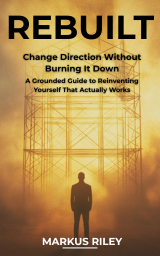
*Staying stuck has a price tag most people never stop to read.* **Rebuilt** helps you calculate it honestly — and shows you how to start moving without dismantling what you’ve already built.
** Click the cover below to learn more and get your copy now.**